
With the busy Graduation Show period fast approaching, we are looking back at last year’s exhibition by highlighting thought-provoking and inspiring projects from each department.
The Master Industrial Design is a programme for innovative thinkers who wish to redesign industry, encouraging a focus on material research and sustainability. Over two years they explore the transformative potential of design while questioning the existing structures of production.
Tracing material stories
In their design research, many students of MID follow the thread all the way back to the origins of materials — how they are extracted, mined, grown, produced, discarded — and the history, ethics, and potential futures tied to them.
The other side of the coin by Herman Hondebrink


In his project “The other side of the coin”, Herman Hondebrink uses nickel as a vehicle through which to explore extraction, colonialism, displacement, ‘green’ processes, and his own family history.
Using Dutch Guilders (the coins abandoned when the €uro arrived) to carry out the process of electrolysis, Hondebrink transforms these obsolete objects into modern currency — nickel is a crucial element in the production of electric vehicle batteries. His installation highlights the continued reliance on destructive extraction methods, even in new ‘green’ scenarios.
Hondebrink shares, “Over the course of MID, I developed a way of working where I seek to bring together personal histories and product-design knowledge and skills, in conversation and collaboration with scientists and activists… ultimately learning and revealing that when products come from ‘somewhere else’, they will always alter distant landscapes.”
'DEAD' STOCK the ghosts of our clothes by Lucy Vink

In “'DEAD' STOCK the ghosts of our clothes” Lucy Vink also explored the production, value, afterlife, and transformation of material — in this case fabric.
Using Cirtex (a textile sorting center in Tiel) as a case study, Vink explored the urgency around textile waste in a fast-fashion society. Harnessing the vernacular of the system, she focused on the three categories of deadstock: Utility (the unusable), Hygiene (the unworthy), and Relevance (the undesirable), creating installations that reflected each one, preserving, and giving new life to, the story of each piece.
CRAFTING CONTAGIOUS CONNECTIONS - Pedagogies of the Hand by Akash Kumar

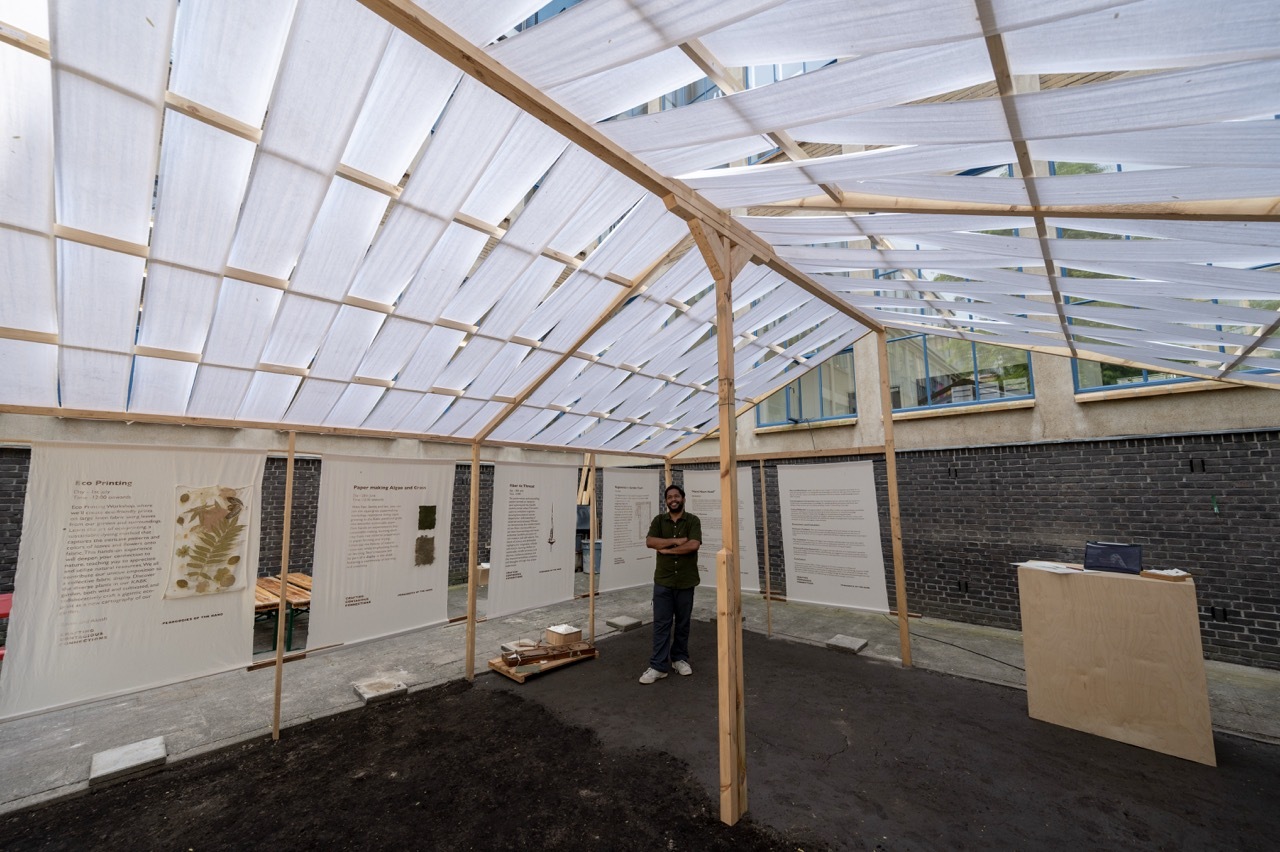
In “CRAFTING CONTAGIOUS CONNECTIONS - Pedagogies of the Hand”, Akash Kumar brings materiality to the forefront through physical touch and presence.
A shed, built in the KABK garden became the site of workshops for processes including natural dyeing, spinning, and eco printing during the Graduation Show period. This set-up was the manifestation of a year-long participatory research project, that involved a diverse range of people, across generations, professions, and backgrounds. The emphasis on learning-by-doing grew from Kumar’s early relationship with his grandmother, whose hands-on approach to nature and materials deeply impacted him.
On his time at the academy, Kumar says; “At the Master of Industrial Design department, I learned to integrate practical skills with intellectual and emotional insights. After graduating, I aim to share my knowledge and design through a holistic approach, using hands, heart, and head to inspire others and promote a comprehensive understanding of learning and creating.”
Feeling inspired?
Come and explore the work of this year's Master Industrial Design graduates (and many more!) at the KABK Graduation Show 2026.


